Audio version
Introduction: When “Beautiful” Stops Working
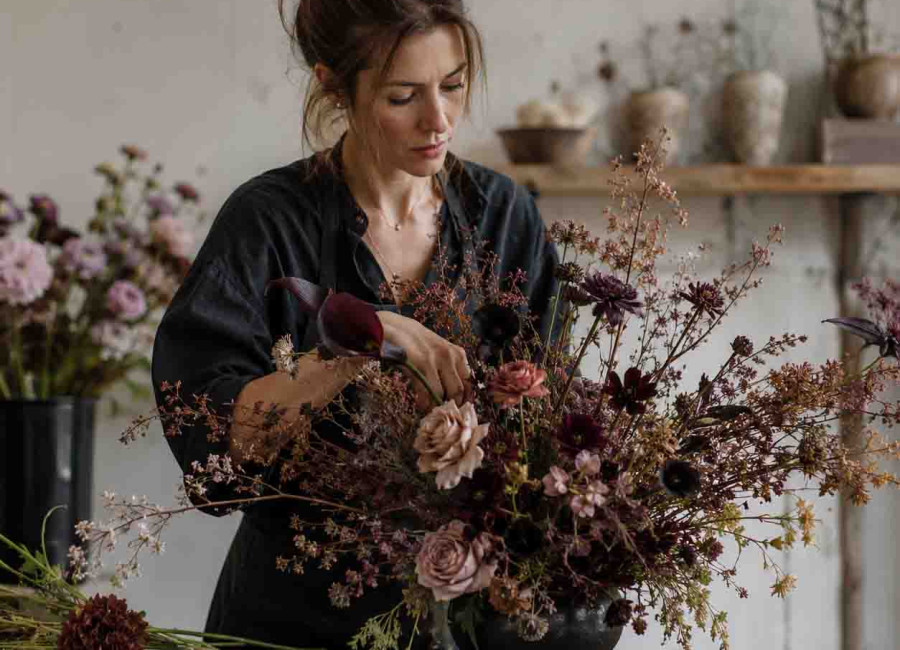
For a long time, floristry relied on the concept of universal beauty. Harmony, symmetry, rich colors, and lush arrangements shaped the perception of what a quality bouquet should look like. However, in recent years, and especially by 2026, it has become increasingly clear that this model is losing its influence. More attention is being drawn to compositions that would be difficult to describe as beautiful in the traditional sense: muted tones, asymmetry, dry textures, unconventional forms, and a sense of incompleteness.
This phenomenon has unofficially become known as dark floristry. Yet its essence goes far beyond a visual style. It represents a shift in how value is perceived. A bouquet is no longer an object that is supposed to appeal to everyone; it becomes an object designed to provoke a reaction. And that reaction—even when it includes a degree of discomfort—becomes a new form of attractiveness.
For businesses, this signals a significant change in the rules of the game. Because when something “ugly” sells, it is more than a trend. It is a sign of a transformation in demand.
What Is Dark Floristry: Not an Aesthetic, but a Shift in Perception
It is important to understand that dark floristry is not simply a collection of visual techniques. It represents a different approach to creating floral compositions. In traditional floristry, the goal is to enhance aesthetic appeal. In the dark approach, the goal is to create tension, depth, and character.
This is expressed on several levels. First, through color: moving away from bright and “clean” shades toward complex, muted, and sometimes even deliberately “dirty” color combinations. Second, through form: abandoning symmetry and perfect roundness in favor of asymmetry and disruption. Third, through texture: using dried elements, unconventional materials, and contrasts between living and fading components.
However, these elements only work when they are guided by a coherent concept. Dark floristry is not about “making something strange”; it is about “making something meaningful.” Without an underlying idea, such a bouquet quickly turns into visual noise.
Why the “Ugly” Becomes Attractive: The Psychology of Perception in 2026
The key factor is the changing perception of consumers. Modern customers live in an environment of visual overload. Every day they encounter hundreds of “beautiful” images, and their brains gradually stop responding to standard aesthetic solutions. Beauty becomes background.
In this context, the “ugly” begins to function as an attention trigger. It disrupts expectations. The eye lingers because it cannot immediately categorize what it sees. This creates engagement.
An additional factor is the novelty effect. Unusual forms and combinations generate interest because they differ from familiar patterns. Even when the initial reaction is not entirely positive, it is usually stronger than a neutral response.
Another important characteristic is that dark floristry often works through a sense of ambiguity. The bouquet does not provide a ready-made answer. It invites interpretation. And this is precisely what makes it more meaningful to the customer.
The Emotional Shift: From Joy to Depth
Traditional floristry primarily focuses on positive emotions: joy, tenderness, and romance. This is a safe and understandable emotional range. However, it is also limited. Dark floristry expands that spectrum.
A bouquet can communicate more complex emotional states: calmness, melancholy, tension, or inner silence. This makes it a more mature product. It is no longer associated exclusively with celebration; it becomes a tool for expression.
For customers, this creates a new level of interaction. They are not simply purchasing a beautiful object—they are purchasing a feeling. And that feeling can be more precise and meaningful than a standard expression of happiness.
Why Businesses Fear This Trend
Despite growing interest, many companies are not prepared to work with dark floristry. The reason is risk. Such products are more difficult to sell because they are not universal. They do not appeal to everyone.
The first concern is lower conversion rates. Businesses worry that unconventional bouquets will be harder to sell. The second concern is customer misunderstanding. There is a risk that the arrangement may be perceived as poorly executed rather than intentionally designed. The third concern is execution complexity. This style demands a higher level of skill and artistic understanding.
However, it is important to recognize that these risks are not caused by the trend itself but by its incorrect application. Dark floristry does not function as a mass-market product. It functions as a differentiation tool.
Where Dark Floristry Is Already Working: Segments and Use Cases
This approach is developing most actively within premium and niche floral studios. In these segments, customers are more willing to experiment and actively seek uniqueness. The bouquet becomes an extension of personal style.
Dark floristry is also widely used in interior styling, photography, creative productions, and brand communication. In these contexts, the objective is not universality but impact. Dark floristry provides a visual language that stands out.
In the mass market, the trend is emerging more gradually through selected colors, forms, and design elements. Full adoption remains slow because it requires a broader shift in consumer perception.
The Economics of the Trend: How the “Ugly” Increases Prices
From a business perspective, one of the most interesting effects of dark floristry is its influence on pricing. It allows companies to move beyond a direct dependence on the quantity and cost of flowers.
The bouquet begins to be perceived as an idea-driven object. This places it in a different category where pricing is determined not by production cost but by perceived value. Customers pay for uniqueness, emotion, and experience.
At the same time, competition decreases. Such bouquets are difficult to compare because they have few direct equivalents. This reduces pricing pressure.
As a result, the “ugly” becomes a tool for increasing margins.
Mistakes That Kill Dark Floristry: Where Businesses Lose Money, Not Just Style
The main problem with dark floristry is not the style itself but its superficial implementation. Businesses often view it as a visual technique rather than a change in product logic. As a result, they create arrangements that look unconventional but lack internal structure or meaning. Instead of strengthening the brand, these bouquets create an impression of randomness and reduce customer trust.
The most common mistake is imitation without understanding. When florists copy external elements of the trend—dark colors, dried textures, asymmetry—but fail to build a coherent composition, the result becomes visually heavy and difficult to interpret. Customers do not perceive it as a deliberate artistic decision; they perceive it as a mistake. This directly affects sales. The bouquet does not command a higher price and may even perform worse than a traditional arrangement.
The second mistake is overloading the composition. In an attempt to create something different, too many contrasting elements are added, destroying balance. Dark floristry requires even more discipline than classical floristry because every mistake becomes more noticeable. In an overloaded composition, the concept disappears and only chaos remains.
The third mistake is the absence of context. Even a strong artistic bouquet may fail commercially if it is presented incorrectly. The visual language must be supported by packaging, merchandising, photography, and communication. Without this support, customers do not understand that they are looking at an idea-driven product. Instead, they see an unusual variation of a classic bouquet. As a result, businesses lose not only sales but also the opportunity to establish a new market position.
How to Use the Trend in Business: From Experiment to Systematic Strategy
The biggest mistake companies make when adopting trends is treating them as experiments rather than strategies. Dark floristry does not work as a one-time campaign or temporary direction. It begins to generate results only when it becomes part of the product logic.
The first stage is integration rather than radical transformation. Businesses should gradually introduce new color palettes, forms, and textures while observing customer reactions. This reduces risk and allows adaptation without alienating the existing audience. It is important not to mix styles randomly but to create clearly defined product lines so customers can distinguish between categories.
The second stage is the development of a visual language. Dark floristry requires consistency. If bouquets look contemporary while packaging and displays remain traditional, a disconnect emerges. The brand must communicate a unified style at every level—from the product itself to customer communication. Only then does the trend function as positioning rather than experimentation.
The third stage is pricing strategy. Dark floristry provides an opportunity to increase prices, but only when customers clearly perceive the value. This requires effective presentation through photography, descriptions, and storytelling. Customers must understand that they are purchasing more than flowers—they are purchasing an idea. Without this understanding, higher prices appear unjustified.
For this reason, implementing the trend is not a matter of taste. It is a matter of systematic product development.
How the Market Is Changing in 2026: From Universality to Perception-Based Segmentation
One of the most significant changes accelerating by 2026 is the decline of universality. The market is moving away from serving an “average taste” and toward segmentation based on perception. This means there is no longer a single correct style. Instead, there are multiple audiences with different expectations.
Dark floristry is part of this transformation. It creates a segment of customers who are not looking for conventional beauty but for individuality. These customers are willing to pay more, but they also expect a stronger alignment with their personal perception. For them, it is less important that a bouquet appeals to everyone and more important that it feels personally meaningful.
As a result, the market becomes divided. The mass segment continues to rely on traditional solutions where predictability matters most. Premium and niche segments move toward idea-driven products where meaning is the primary value. These segments do not compete directly because they serve different expectations.
This shift is critically important for businesses. It means that it is no longer possible to be both “for everyone” and “full of character” at the same time. A position must be chosen. And trends such as dark floristry help define that position.
Conclusion: The “Ugly” as a Tool for Escaping Price Competition
The main conclusion is that dark floristry is not primarily about aesthetics—it is about economics. It changes not only the appearance of a product but also its position in the market. A bouquet stops competing through the quantity and cost of flowers and begins competing through perception.
This fundamentally changes the business model. When a product is perceived as standard, it inevitably enters price competition. When it is perceived as unique, comparison becomes difficult. This allows businesses to shape pricing rather than simply react to it.
In this context, the “ugly” is not a rejection of beauty but a redefinition of it. It represents a shift from the universal to the individual, from the safe to the expressive. And it is precisely this transition that creates new value.
In 2026, the companies that succeed are those that understand that trends are not merely fashion—they are signals. Signals of how customer perception is changing. The sooner a business adapts to that change, the stronger its position in the market will become.
Your experience matters! Take a short survey and see what answers other flower business representatives gave. Take part