Audio version
Introduction: The Industry’s Greatest Temptation — Removing Humans from the Process
For decades, floristry has been regarded as a craft in which the greatest value is created by human hands. It is the florist who determines the shape, balance, composition, and character of a bouquet, transforming a collection of flowers into a product with emotional and visual value. However, as the market expands and competition intensifies, the industry is increasingly asking a fundamental question: can the human element be removed from this process and replaced by technology?
From a business perspective, the idea appears highly attractive. Automation promises lower labor costs, standardized quality, greater scalability, and reduced dependence on skilled personnel.
By 2026, interest in automation is being driven not only by technological progress but also by economic realities. Rising labor costs, shortages of qualified florists, and the need to accelerate production are pushing companies to seek alternative solutions. At first glance, automated bouquet assembly seems perfectly logical: if clothing, food, and furniture manufacturing can be automated, why shouldn't floristry follow the same path?
The reality, however, is far more complex.
Unlike industries built around rigid standardization, floristry works with living materials and highly subjective visual perception. As a result, the challenge of automation is not merely technical—it is conceptual. The real question is not whether a bouquet can be assembled without a florist, but whether its perceived value can be preserved in the process.
What Exactly Is Being Automated? Breaking Down the Bouquet Creation Process
To understand the true potential of automation, the bouquet creation process must first be divided into its individual stages. One of the biggest mistakes companies make is treating floristry as a single workflow, when in reality it consists of several independent operations: procurement, sorting, storage, preparation, bouquet assembly, packaging, and delivery.
Automation has already been successfully implemented in many of the early stages. Warehouse management systems monitor flower freshness, track inventory levels, and forecast purchasing requirements. Automated production lines can trim stems, remove leaves and thorns, and prepare floral materials for assembly. These technologies reduce the workload on employees while minimizing operational errors.
The most critical stage, however—bouquet assembly—remains the greatest challenge.
This is the point where interpretation becomes essential. Decisions about stem angles, volume distribution, balance, and visual harmony are not based on rigid rules but on aesthetic judgment. These choices rely on human perception rather than fixed algorithms, making this level of decision-making extremely difficult to automate.
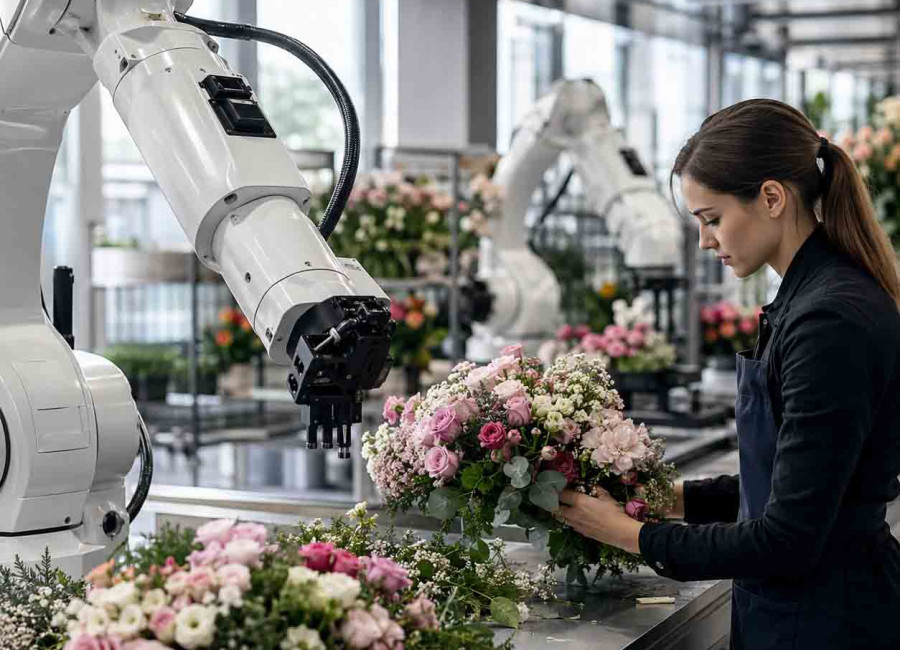
As a result, automation in floristry is evolving not as a complete replacement for florists, but as a fragmentation of the production process. Technology increasingly takes over repetitive and standardized tasks while leaving the creative core of bouquet design in human hands.
Technologies in 2026: Where Automation Truly Stands Today
By 2026, automation technologies have reached a level where they can partially reproduce compositional decisions. Robotic systems are capable of repeating predefined bouquet designs, applying algorithms to distribute floral elements, and even adapting to basic production parameters. Artificial intelligence can analyze images, recognize composition patterns, and generate bouquet design recommendations.
The challenge, however, is that these systems perform well only within environments characterized by limited variability. They are highly effective when products can be standardized. In the mass-market segment, this delivers tangible results: simple bouquets, fixed product models, and minimal variation from one arrangement to another.
The situation changes dramatically as soon as a bouquet requires creative interpretation beyond predefined templates.
Fresh flowers introduce an enormous number of variables that are difficult to predict and standardize. Even slight differences in flower size, stem curvature, bloom shape, or degree of opening can significantly alter the final composition. While a human florist instinctively adjusts to these differences, a machine cannot always interpret and compensate for them correctly.
As a result, technology is already transforming the floristry industry, but its practical application remains largely confined to standardized market segments.
Why Full Automation Is Impossible: The Challenge Lies in Perception, Not Technology
The greatest limitation of automation is not the current state of technology but the nature of the product itself.
A bouquet is more than a physical arrangement of flowers—it is a visual object evaluated through subjective perception. Its value is determined not only by how accurately it has been assembled but by how it is experienced by the customer.
This means that even technically flawless execution does not automatically create value. A machine may produce a perfectly symmetrical, neat bouquet, yet the result can still appear lifeless or lacking in character. A skilled florist, on the other hand, may deliberately break conventional compositional rules to achieve a more emotionally compelling outcome.
Context introduces another critical variable.
The very same bouquet may be perceived differently depending on the occasion, the customer, the presentation, or even the surrounding environment. These contextual nuances cannot be fully formalized, making them extremely difficult for automated systems to evaluate.
Consequently, the primary limitation of automation is not the ability to assemble flowers, but the inability to fully reproduce human perception and aesthetic judgment.
Where Automation Delivers the Greatest Value: The Economics of the Mass Market
Despite these limitations, automation already provides significant competitive advantages within the mass-market segment.
Here, uniqueness is not the primary objective—efficiency is.
Bouquets are standardized, variation requirements are minimal, and production volume becomes the dominant economic factor.
Under these conditions, automation lowers production costs, accelerates manufacturing, and delivers more consistent quality. This enables companies to process larger order volumes while maintaining competitive pricing.
It is important to recognize, however, that this represents a fundamentally different product category.
In this segment, the bouquet becomes a commodity rather than an object of emotional perception. While this limits opportunities to create additional value through uniqueness, it significantly strengthens competitiveness through operational efficiency and scale.
How the Florist’s Role Is Changing: From Craftsman to System Architect
As automation continues to develop, the florist is gradually shifting away from being the center of physical production and toward becoming the architect of both the product and the system that creates it.
This represents a fundamental transformation.
In the past, a florist’s value was measured by the speed and quality of manual bouquet assembly. Today, that value is increasingly defined by the ability to design a production model capable of consistently delivering bouquets with the desired level of quality, visual appeal, and customer perception.
Modern florists spend less time working with their hands and more time working with systems and decision-making.
They determine which bouquet designs can be standardized, which elements require flexibility, and where the boundary should lie between automation and manual craftsmanship. This demands not only artistic taste but also a solid understanding of business fundamentals, including production costs, operational efficiency, consistency, and customer behavior.
In many ways, the florist becomes the bridge between the product itself and the company's operational system.
Quality control also becomes increasingly important.
In an automated environment, it is not enough to design the system—it must also be continuously monitored and refined. Even standardized bouquet models are influenced by the natural variability of fresh flowers, and it is the florist who decides when human intervention is necessary.
As a result, the florist evolves from an operator into a quality manager responsible for preserving the product's visual and emotional value.
This transformation raises the professional standards of the occupation while simultaneously increasing its strategic importance.
An experienced florist is no longer simply a replaceable production employee but becomes a key strategic asset. Companies that fail to recognize this shift risk either losing the quality of their product or failing to achieve the expected benefits of automation.
How Automation Is Reshaping the Market: The Emergence of Industrial and Product-Oriented Floristry
Automation is doing far more than changing internal business processes—it is restructuring the floristry market itself by creating a clear distinction between two fundamentally different business models.
The first is industrial floristry, built around scale, speed, and standardization.
The second is product-oriented floristry, where value is driven by creativity, interpretation, and individuality.
The industrial model thrives through automation.
Its competitive advantage comes from reducing production costs, accelerating manufacturing, and delivering consistently predictable quality. This is the segment dominated by marketplaces, large retail chains, and online platforms, where reliability and operational efficiency matter most.
Within this model, a bouquet becomes a standardized product that must meet customer expectations, but not necessarily exceed them. Competition is driven primarily by price, logistics, and delivery speed.
The product-oriented model follows the opposite path.
Its strength actually increases because automation has clear limitations.
Here, value is created through artistic interpretation, making every bouquet unique and difficult to compare directly with another. These arrangements are challenging to standardize and even more difficult to automate because their greatest strength lies in variation rather than consistency.
As a result, competition shifts away from price and toward perception, while profitability is built upon uniqueness and creative value.
Importantly, these two business models do not compete directly with one another.
A customer purchasing an affordable, quickly delivered bouquet is not comparing it with a handcrafted designer arrangement from a boutique floral studio.
This means the market is no longer a single competitive landscape but a multi-layered ecosystem in which each business model operates according to its own economic principles.
For businesses, this creates the necessity of making a strategic choice.
Trying to position a company somewhere between these two models often results in losing both advantages. The product is no longer inexpensive enough for the mass market, yet not distinctive enough for the premium segment.
The companies that succeed are those that clearly understand which model they operate within and build every business process around that strategic direction.
Conclusion: Automation as a Tool That Strengthens the Strong and Exposes the Weak
The key takeaway is that automation in floristry is not a universal solution that automatically improves a business. Instead, it acts as an amplifier: it strengthens a company's existing advantages while simultaneously exposing its weaknesses. If a business has well-designed processes, a clear product strategy, and effective quality control, automation increases efficiency and scalability. If those foundations are missing, automation simply accelerates chaos.
The reason is straightforward: technology does not replace strategy.
Automation can optimize processes, but it cannot determine what kind of product customers truly want or why they should be willing to pay for it. Those decisions remain fundamentally human. This is where the dividing line lies between companies that use automation as a growth tool and those that mistakenly view it as a substitute for strategic thinking.
By 2026, automation has become one of the key forces reshaping the floristry market, but it has not changed its fundamental principles. The flower business remains a business of perception, where value is created not only through the product itself but also through the meaning and emotions associated with it. Technology can accelerate production, but it cannot replace creativity or ideas.
For this reason, the most important question for any business is no longer, "Can floristry be automated?" Instead, it is, "Which parts of the process should be automated without reducing the product's value?"
The answer to that question ultimately determines whether a company will achieve sustainable growth or remain trapped in an endless competition based solely on operational efficiency.
Your experience matters! Take a short survey and see what answers other flower business representatives gave. Take part