Audio version
Introduction: Where the Real Value of a Bouquet Is Created
In the floral industry, the dominant logic still assumes that product quality is directly tied to the quality of the raw materials. Supplier selection, flower variety, bud size, and freshness are widely perceived as the key factors. Purchasing decisions are built around them, sales arguments rely on them, and the perception of an “expensive” bouquet is often formed through them. This model is convenient because it is measurable and easy to understand. However, in the reality of 2026, it explains only part of the outcome and often distracts businesses from the actual point where value is created.
In practice, identical flowers can produce fundamentally different results. One bouquet is perceived as premium, confident, and cohesive, while another appears random, overloaded, or visually “cheap,” despite having the same production cost. This means that value is not created at the material level but through the way the material is used. The florist’s hand becomes the key factor that determines whether a bouquet can be sold at a higher price, retain customers, and strengthen a brand.
The market’s primary imbalance lies in the fact that investments are directed toward raw materials rather than assembly. As a result, businesses pay for potential but fail to realize that potential in the final product. This creates an illusion of quality that does not translate into revenue.
The Florist’s Hand as a System: What Actually Creates the Product
When people talk about a florist’s “hand,” they often mean taste or talent. In reality, however, it refers to a system of skills that directly influences perception. It is the ability to control form and transform a collection of elements into a composition with structure and logic. A florist with a strong hand does not simply combine flowers; they build a structure in which every element contributes to the overall result.
The key components of this system are balance, proportion, depth, rhythm, and focal points. Balance creates stability, preventing a bouquet from appearing visually tilted. Proportion creates harmony and a sense of correctness. Depth makes a composition dimensional and layered rather than flat. Rhythm guides the viewer’s eye through the arrangement, while focal points direct attention toward what matters most.
Importantly, all of these elements exist independently of the flowers’ cost. They are created during the assembly process. That is why the same materials can appear either as a refined product or as a random collection of stems.
How Customers Perceive Arrangement: The Psychology Few Discuss
Customers almost never analyze a bouquet rationally. They do not consciously evaluate proportions or depth. Yet they instantly sense whether a bouquet feels “assembled” or not. This happens at the perception level, and this is precisely where arrangement becomes decisive.
The first level is processing speed. A structured bouquet is easy to read: the eye quickly finds a focal point, understands the shape, and settles on it. This creates a sense of confidence and makes decision-making easier. A weak arrangement requires more effort. The eye struggles to focus, uncertainty emerges, and the likelihood of purchase decreases.
The second level is the feeling of control. When a composition is thoughtfully structured, customers sense that a professional created it. This builds trust. When structure is absent, the arrangement feels accidental, even if the flowers themselves are expensive.
The third level is emotional response. Structure creates visual calmness. Overloaded or chaotic bouquets create internal tension. Customers rarely articulate this feeling, but they respond to it nonetheless.
This is why arrangement influences purchasing decisions far more than many businesses realize. It operates at a subconscious level.
One Material, Two Outcomes: How Value Is Lost or Created
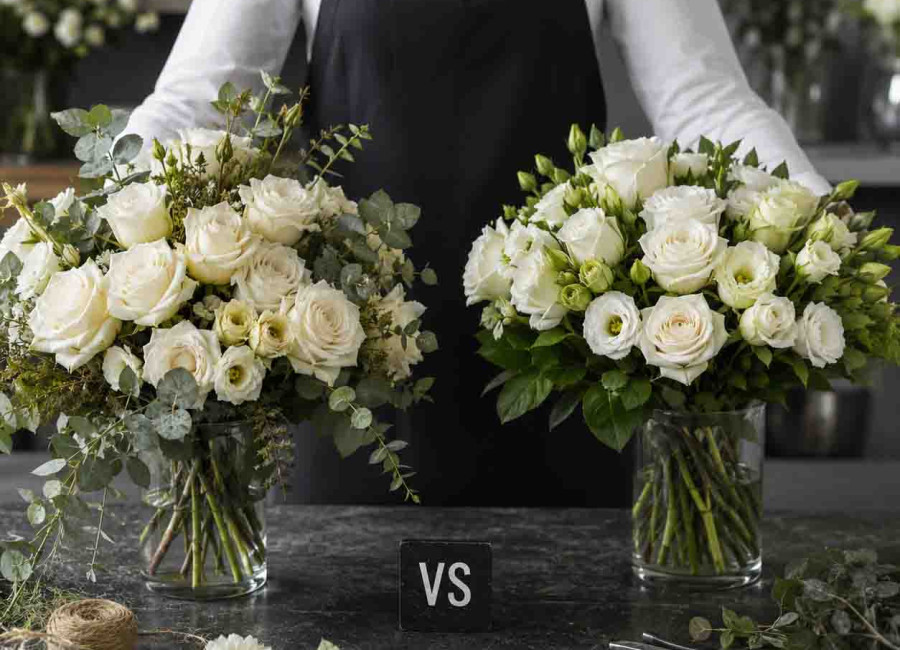
Imagine the same batch of flowers: mid-range roses, some seasonal greenery, and a few basic additions. In one case, the florist builds the bouquet around a clear form, creating a focal point, distributing volume thoughtfully, leaving breathing space, and adding depth. In another case, elements are added without a clear logic, simply to fill space.
In the first scenario, the bouquet appears refined and expensive despite the simplicity of the materials. In the second, it looks overloaded and less valuable despite containing the exact same flowers. The difference in selling price can reach dozens of percentage points even though the production cost remains identical.
This situation occurs every day, yet it is rarely recognized as a system. Businesses notice differences in sales performance but often attribute them to assortment rather than arrangement. As a result, the true cause remains hidden and the problem remains unsolved.
Why Expensive Flowers Cannot Save Poor Arrangement
Attempting to compensate for weak arrangement with expensive flowers is one of the most common mistakes in the industry. It appears logical: if the materials are premium, the result should also be premium. However, without structure, expensive flowers lose much of their value because they are not properly organized.
Moreover, this often amplifies the negative effect. Customers expect a high-end experience but receive an average result. The gap between expectation and reality has a stronger impact on perception than if the bouquet had been simple from the start.
From an economic perspective, this means that a business increases costs without increasing value. Margins decline, and overall efficiency suffers.
Where Skill Becomes Revenue: The Direct Business Impact
Strong arrangement is not merely aesthetics; it is a revenue-generating tool. First, it allows bouquets to command higher prices. Arrangements with clear structure are perceived as more valuable, and customers are willing to pay more for them even if they cannot explain why.
Second, it improves conversion rates. When faced with multiple options, customers make decisions faster when a composition is visually clear and understandable. This is particularly important in online sales environments.
Third, it affects repeat purchases. A bouquet that maintains its form at home and does not fall apart creates a positive customer experience. As a result, customers are more likely to return.
Arrangement therefore influences three critical business metrics: average order value, conversion rate, and customer lifetime value (LTV). This makes it one of the most underestimated drivers of business performance.
Why Poor Arrangement Damages Brand Trust
One of the most overlooked effects of arrangement is its impact on trust. Customers may know little about floristry, but they remember the result. If a bouquet quickly loses its shape, looks different from how it appeared at purchase, or fails to meet expectations, trust declines.
The challenge is that customers rarely connect the problem to a specific cause. They do not say, “The structure was poor.” They simply do not return. This makes the losses difficult to identify.
As a result, weak arrangement functions as a hidden factor that gradually erodes a brand from within. This is far more dangerous than occasional mistakes.
Why the Market Still Prioritizes Raw Materials
Despite the obvious effects, the market continues to overvalue flowers themselves. The reason is convenience. Raw materials can be measured, compared, and calculated. They provide a sense of control. Arrangement is more complex; it requires training, standardization, and time.
Communication also plays a role. It is easier to explain flowers to customers than to explain structure. This makes raw materials a more convenient sales tool.
Yet this very logic limits business growth because it ignores the factor that matters most: the product itself.
How the Market Is Changing: The Shift Toward Quality of Form
In 2026, a gradual shift is taking place. Customers are becoming increasingly sensitive to form, even if they cannot explain it. They are beginning to recognize differences in arrangement quality and respond accordingly.
Florists who emphasize structure are gaining an advantage. Their bouquets look more modern, more professional, and more durable. They perform better in the premium segment and help create stronger brands.
This means that competitive advantage is moving away from assortment and toward execution.
What This Means for Businesses: A New Growth Opportunity
If growth was previously driven by purchasing, it is now becoming increasingly linked to arrangement quality. This requires investment in training, standards, and quality control. Businesses must develop a shared understanding of structure across their teams.
This approach is more difficult than simply buying better flowers, but it delivers more sustainable results. The business becomes less dependent on external factors and more controllable internally.
Conclusion: Flowers Are Potential, the Product Is Created by Human Hands
The key conclusion is simple: flowers are only potential. They can become a product, or they can fail to become one. Everything depends on how they are used. It is the florist’s hand that transforms raw material into value—value that can be sold, remembered, and capable of retaining customers.
In 2026, the winners are those who treat arrangement as a core asset. Because in the end, it is arrangement that determines what a bouquet is truly worth.
Your experience matters! Take a short survey and see what answers other flower business representatives gave. Take part