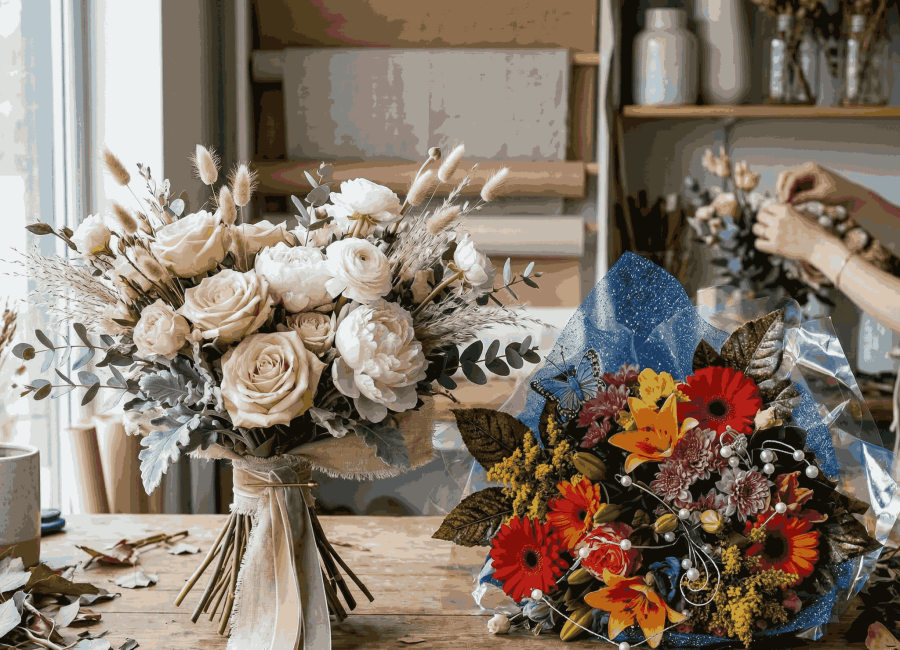
Bouquet design is traditionally perceived as an absolute plus. Complex shapes, unusual combinations, and a signature touch—all of this seems like a direct path to higher value.
But in practice, florists increasingly face a paradox: the more complex and expressive the design, the harder it is to sell.
This doesn't mean design "doesn't work." It just means its impact on value and sales isn't linear.
What is the value of a bouquet from a client's perspective?
For a client, the value of a bouquet isn't the level of complexity or the number of elements.
It comes from a sense of appropriateness, clarity, and inner acceptance of the choice.
A bouquet may be technically flawless, but if the client doesn't understand why this particular design is needed for their situation, the value is lost.
When design enhances value
Design begins to enhance value when it supports the meaning of the purchase rather than distracts from it.
In such cases, the shape helps the customer feel that the bouquet:
- perfectly suits the occasion or mood,
- reflects a relationship rather than a display,
- seems to be worth the price.
Here, design becomes a language that explains the choice without words.
The relationship between form and context
The same design can be perceived differently depending on its context.
A composition that looks striking in a photo or at an exhibition may be too complex for an everyday gift.
When form and context clash, the customer feels an internal discomfort.
They may not be able to articulate the reason, but the purchase decision is delayed.
When design starts to hinder sales
Problems begin when design exists on its own.
If a design requires explanation, justification, or effort on the part of the client, it ceases to contribute to the sale.
Design most often hinders sales when:
- it is overloaded with details and perceived as "too much,"
- it looks impressive but its purpose is unclear,
- it emphasizes the florist's authorship more than the client's request.
In such cases, design enhances aesthetic value but reduces willingness to buy.
The "fear of mistake" effect
The more complex and unusual the design, the greater the risk the client perceives.
They begin to doubt:
- how will the recipient react?
- will the bouquet seem strange or inappropriate?
- will they regret their choice?
Even if the price is objectively justified, the design can increase the fear of error—and the sale will fail.
Custom design and mass demand
A custom approach is an important part of floristry, but it's not always scalable.
A design that works well for a custom order may not convert well in a storefront or online.
A mass customer is more often looking for:
- a clear visual code,
- a tangible emotion,
- a sense of a "safe" choice.
When a design is too custom, it requires dialogue.
Without this dialogue, sales become more difficult.
Where is the balance drawn?
The line between a design that adds value and one that hinders sales is drawn not by the level of complexity, but by the level of readability.
A well-functioning design:
- is read quickly,
- requires no explanation,
- leaves room for the customer's interpretation.
A poorly functioning design:
- overloads attention,
- imposes an idea,
- makes choice stressful.
How the florist's role is changing
At this point, the florist's role shifts from "form creator" to "meaning translator."
It's important not only to come up with a design but also to understand where it will enhance value and where it will create a barrier.
Florists increasingly become a mediator between aesthetics and the actual purchase.
Why is this especially important today?
As awareness grows, customers are increasingly less likely to buy "for the experience."
They are looking for consistency between form, meaning, and price.
This means that design can no longer exist separately from the task of selling.
It either helps the customer say "yes" or makes it more difficult.
Conclusion
Bouquet design adds value when it helps the customer feel confident in their choice.
It hinders sales when it becomes an end in itself and requires unnecessary effort from the customer.
The most sustainable floral solutions are those where the form doesn't overtly express itself, but rather emphasizes meaning and appropriateness.
Your experience matters! Take a short survey and see what answers other flower business representatives gave. Take part