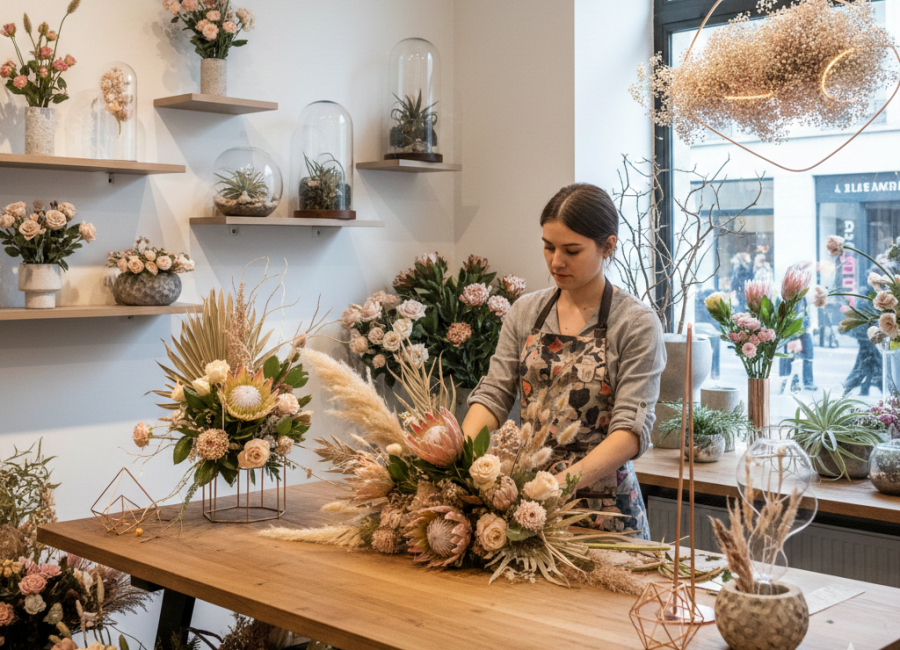
In recent years, visual trends in floristry have ceased to be simply aesthetic guidelines. They increasingly influence a florist's daily work—the choice of materials, the assembly process, client communication, and even their professional identity.
While trends once inspired, today they increasingly define the working framework within which florists must exist.
The visual environment as a new point of reference
Modern floristry operates in a constant visual flux. Social media, catalogs, marketplaces, and educational platforms form a unified visual field in which florists work daily.
This changes the point of reference.
The work begins not with the flower or the shape, but with the image—with how the bouquet should appear in the frame, how it "reads" on the screen, and how recognizable it is in the general visual noise.
As a result, florists increasingly think not only as designers but also as visual editors.
Shifting focus from material to image
Traditionally, florists began their work with the material: freshness, texture, seasonality, and the flower's behavior in the arrangement.
Under the influence of visual trends, the focus is shifting toward image.
Florists increasingly:
- select flowers to fit a predetermined shape,
- sacrifice the properties of the material for visual effect,
- focus on the visual result more than the stability of the arrangement.
This changes not only the outcome but also the very logic of professional thinking.
Acceleration of work pace and burnout
Visual trends evolve faster than practice can physically adapt.
Florists find themselves in a constant state of catch-up: new shapes, new combinations, new expectations.
This rhythm:
- reduces time for reflection,
- increases the sense of impermanence of results,
- increases the risk of professional burnout.
Work begins to be perceived as a never-ending display case update rather than skill development.
Pressure of trends on the author's style
One of the most noticeable effects is the erosion of individual visual language.
When a trend becomes dominant, it becomes more difficult for florists to defend their own style and taste.
Clients increasingly come not for interpretation, but for reproduction.
The phrase "make it like the photo" is gradually replacing dialogue about meaning, context, and appropriateness.
As a result, signature style gives way to a visual template.
Changing customer communication
Visual trends are radically changing the format of communication.
Clients come to us already "seen," with established expectations and visual cues.
This creates new challenges for the florist:
- explaining the difference between image and reality,
- adapting a trend to a specific occasion,
- managing expectations without destroying trust.
Communication becomes part of the design process, not an adjunct.
The impact of trends on product range and purchasing
Trends influence not only the shape of a bouquet but also the cost of production.
Certain flowers and textures become popular not because of their properties, but because of their visual appeal.
This is reflected in:
- choice of varieties,
- purchasing structure,
- seasonal decisions.
Sometimes a florist works with materials that are more difficult to handle logistically or less durable, but "win" in the frame. This adds a hidden burden to the process.
When trends stop helping
Over time, it becomes clear that simply following visual trends doesn't produce sustainable results.
Forms quickly become outdated, clients tire of repetition, and florists lose a sense of the value of their work.
At this stage, many begin to seek a different approach—one that's more conscious and flexible.
The transition from copying to interpretation
A more sustainable model is one in which trends are perceived as the language of the times, rather than as instructions.
A florist doesn't copy a form, but rather understands its logic and adapts it to a specific request.
This brings back to the work:
- a sense of authorship,
- connection to the context,
- professional confidence.
The trend stops dictating—it begins to suggest.
How the value of a profession is changing
Against a backdrop of visual pressure, the value of the florist as an interpreter, rather than a performer, is growing.
Clients increasingly value not knowledge of all the trends, but the ability to create a bouquet that is appropriate, understandable, and won't become outdated in a few weeks.
The profession is gradually shifting from artisanal repetition to visual expertise.
Conclusion
Visual trends are changing a florist's work more profoundly than it seems.
They influence thinking, processes, communication, and the overall feel of the profession.
The most resilient florists are those who are able to work with trends consciously—using them as a tool, but not allowing them to completely define their work.
Your experience matters! Take a short survey and see what answers other flower business representatives gave. Take part