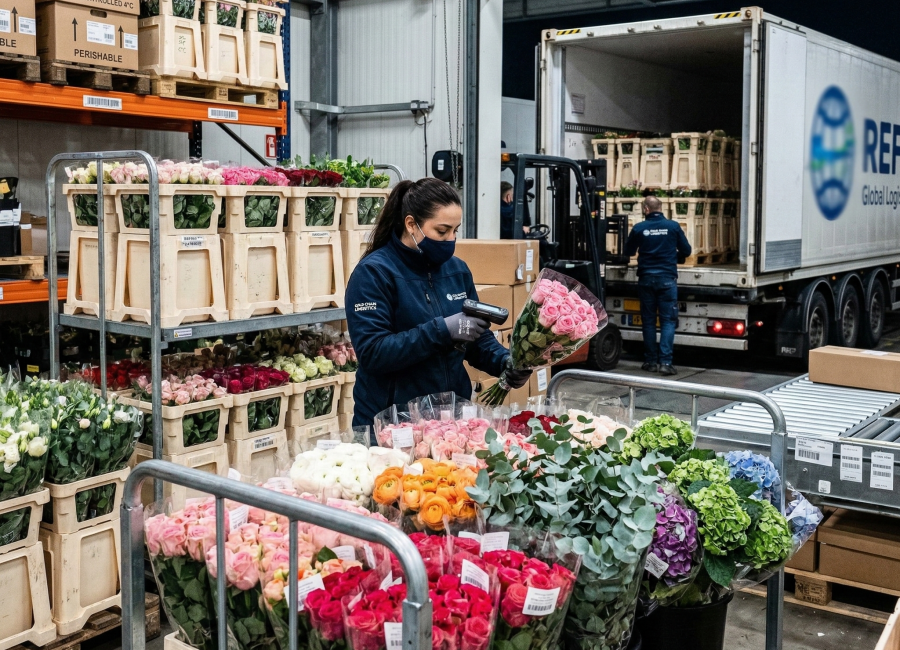
For most clients, the cost of a bouquet is simple: flowers, packaging, and the florist's labor.
Logistics are almost nonexistent in this equation—it's invisible, unfelt, and rarely recognized as part of the value.
However, logistics increasingly determines how much a bouquet actually costs for a business and why identical arrangements can have different economics.
By 2026, logistics will become a key cost factor, while remaining completely hidden from the client.
Why customers don't "see" logistics
Logistics has no visual representation. Customers don't see the delivery route, temperature control, transit times, warehouse handling, or losses during storage. For them, a bouquet is either fresh or it's not. Everything that happens before the picking process remains behind the scenes. This is why logistics is perceived as "something in the background" rather than as part of the price.
How logistics shapes production costs in practice
The production cost of a bouquet is determined not only by the purchase price of the flower. It is influenced by the entire product chain—from the plantation to the display case.
The most sensitive logistics factors are:
- the length and complexity of the supply chain,
- the number of transhipments and warehouse stages,
- temperature requirements,
- losses and write-offs in transit,
- supply instability, and forced substitutions.
Each of these elements can imperceptibly increase production costs without changing the appearance of the bouquet.
Why identical flowers cost businesses so much
Two seemingly identical bouquets can have fundamentally different logistical histories.
One has traveled a short, stable supply chain, while the other has undergone a complex route with delays, additional storage, and increased risks. The customer doesn't notice the difference. But for a business, the difference can be critical—especially when working with tight margins.
Logistics as a source of hidden losses
One of the main problems in logistics is invisible losses.
They are rarely recorded as a separate item, but they directly impact the final cost.
Most often, these include:
- a shortened flower lifespan,
- write-offs due to quality loss,
- forced discounts on leftovers,
- overspending on urgent deliveries.
Ultimately, businesses compensate for logistical risks through the overall price, even if the customer doesn't understand where it comes from.
Why logistics optimization doesn't always reduce prices
Reducing logistics costs doesn't always mean a cheaper bouquet. Sometimes optimization isn't aimed at reducing costs, but at stability and predictability.
Businesses choose:
- more reliable suppliers,
- less risky routes,
- additional quality control stages.
This may increase costs, but it reduces losses and reputational risks.
How logistics are beginning to influence product assortment
As supply chains become more complex, logistics increasingly dictate which flowers are profitable to sell.
Some varieties become too risky to store and transport, even if they are in demand.
As a result, product assortment is determined not only by customer tastes but also by logistical feasibility.
Why does the customer still feel the effects of logistics?
Although logistics remains invisible, its consequences are directly felt by the customer:
- in the durability of the bouquet,
- in the consistency of the product range,
- in the predictability of quality.
If logistics are poor, it is perceived as a problem with the product, not the supply chain.
What does this mean for the market by 2026?
By 2026, logistics will cease to be simply an operational function.
It will become a factor that shapes price, product range, and business sustainability.
Winners are not those who minimize logistics, but those who can manage its impact on costs, even if the customer doesn't see it.
Conclusion
Logistics directly impacts the cost of a bouquet, yet remains completely hidden from the customer.
It doesn't add visual value, but it does determine the economics of the business.
In 2026, the sustainability of the flower market will increasingly depend not on the display window, but on how the logistics system is structured behind the scenes.
Your experience matters! Take a short survey and see what answers other flower business representatives gave. Take part