Latest Blog Posts


Apr 13
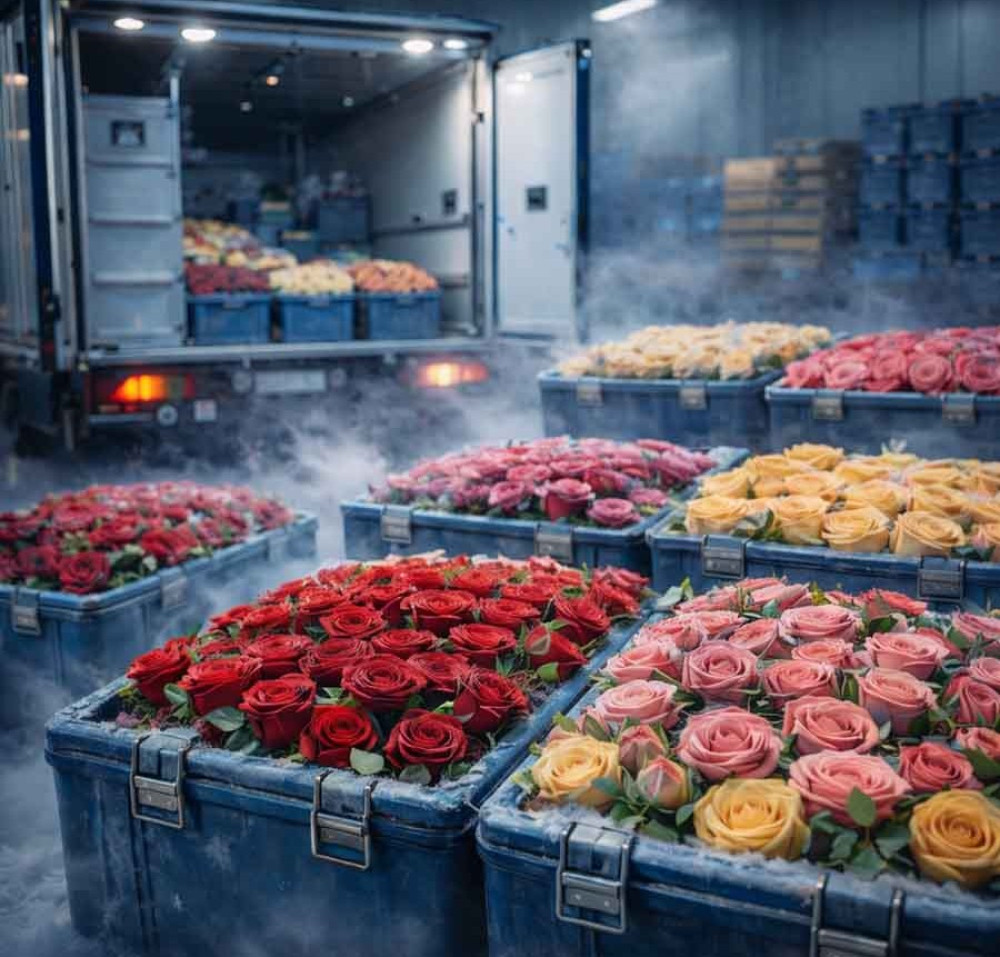
Flowers in transit: where freshness is really lost and how it affects profit
In the flower business, it is commonly assumed that the product is formed at the procurement stage and ends at the display. But in 2026, it becomes clear: a key part of the product exists between these points — in logistics. This is where the real quality of the flower is determined, its lifespan, and ultimately its ability to be sold without losses.
The paradox is that logistics remains one of the most underestimated areas in business management. Most companies perceive it as a technical process: delivered, received, placed in cold storage. In reality, logistics is a system that either preserves money or silently destroys it. A flower that arrives with depleted resources is no longer the same product. It becomes something different, even if it looks normal on the outside.
That is why in 2026 logistics is no longer a background function. It becomes part of the commercial model. Mistakes in this area can no longer be compensated by design, marketing, or pricing.
Freshness is a managed resource, not a visual impression
The main mistake in the market is evaluating freshness by appearance. A flower may look strong, open, and visually “alive,” yet have a significantly reduced lifespan. This means the business is working with a product that has already partially lost its value without realizing it.
In reality, freshness is not a condition but a remaining resource. It is the amount of time during which a flower can be sold and maintain its commercial quality for the customer. This resource begins to be consumed from the moment of cutting and cannot be restored. It can only be preserved or lost.
Every stage of logistics either slows down or accelerates the consumption of this resource. It is important to understand that losses do not occur gradually but in jumps. A small disruption in conditions can lead to a sharp reduction in lifespan. That is why identical batches that follow different routes behave differently in sales.
For business, this means that time becomes as important as price or volume. Managing flowers is managing time.
Where businesses actually lose freshness (and don’t notice it)
Quality loss does not happen at a single point. It is a chain reaction where each stage amplifies the previous one. However, there are several critical zones that determine the outcome.
The first is the moment after cutting. If cooling is delayed or insufficient, the flower begins to lose moisture and stability. This is a foundational level that cannot be compensated later. Even perfect downstream logistics cannot restore lost resources.
The second is transportation. Here, not only temperature but also the stability of conditions plays a key role. Fluctuations, waiting times, and handling transfers all create stress for the product. Particularly risky are moments when control weakens: intermediate warehouses, changes of transport, and delays along the route.
The third is the receiving and internal logistics stage. If the batch is not processed quickly upon arrival, or if it remains outside optimal conditions, additional degradation occurs. Businesses often underestimate this stage, assuming the main work has already been done.
The fourth is distribution within the assortment. If products are not prioritized by lifespan, weaker batches become “lost” among others. They are sold later than they should be, which leads to write-offs.
The illusion of a “fresh flower”: why visuals mislead business
One of the most dangerous traps is trusting appearance. A flower may look perfect upon arrival, but this does not guarantee its performance in sales.
The problem is that degradation first occurs at the level of internal processes: water balance, stem structure, and the ability to maintain form. These changes become visible later. As a result, businesses make decisions based on visual perception rather than the actual state of the product.
This creates a systemic error. The batch is perceived as “normal,” not prioritized, and sold in a standard way. But after a few days, quality deteriorates sharply. At that point, the only options are discounts or write-offs.
Thus, visual assessment becomes a source of financial loss. The business operates with incorrect information and makes decisions that seem logical but lead to losses.
The economics of loss: what one “bad” day costs
Logistics directly impacts revenue, but this impact is often underestimated because it is distributed over time. Losses are not immediately visible — they accumulate.
If a flower loses one day of its commercial life, it means a shorter sales window. The business has less time to sell at a normal price. This leads to several consequences simultaneously.
First, pressure on speed increases. The product must be sold faster than planned. Second, the likelihood of discounts increases. Third, the average margin decreases, as part of the sales shifts into the “risk zone.”
From a systemic perspective, every lost day reduces the profitability of the entire batch. At scale, this becomes a significant amount that is not always directly tracked but affects the final result.
Additionally, indirect losses arise: increased write-offs, reduced customer trust, and higher operational load. All of this makes logistics one of the key drivers of financial performance.
Why identical batches produce different results
One of the most revealing effects is the different performance of identical products. The same flower, purchased from the same supplier, can show different turnover rates and margins.
The reason is that logistics creates variability. Even small differences in transportation or storage conditions lead to different product states. As a result, one batch sells quickly and smoothly, while another requires effort and generates losses.
If a business does not track these differences, it perceives the outcome as randomness. In reality, this is a systemic effect that makes assortment management more complex.
In 2026, companies that begin to account for this variability gain an advantage. They stop working with averages and start managing each batch as a separate resource.
The main mistake: one strategy for different product conditions
Many companies treat their assortment uniformly, regardless of its condition. This is one of the most expensive mistakes.
In reality, different batches require different approaches. A product with full resource can be sold under standard conditions. A product with reduced resource must be sold faster, using different scenarios.
If this does not happen, weaker batches fail to be sold in time. They lose quality exactly when they should have been sold. This creates the effect of “sudden” write-offs, although the cause was predictable.
The correct model is adapting the strategy to the product’s condition. This requires more attention but significantly reduces losses.
How logistics affects sales, not just quality
It is important to understand that logistics affects not only lifespan but also the ability to sell. A product with reduced resource performs worse over time: it opens хуже, loses shape faster, and looks less attractive. This directly affects customer perception.
As a result, not only margins decrease, but conversion also drops. Bouquets made from such material sell worse, even if they look acceptable at the moment of assembly. The customer receives a product that does not meet expectations, which impacts repeat purchases.
Thus, logistics becomes part of marketing. It influences how the product is perceived, sold, and remembered.
What actually reduces losses in 2026
In modern conditions, winners are not those who eliminate all mistakes, but those who react to them faster. Logistics becomes a management area, not just a control function.
In practice, this means several key actions:
• accelerating processing immediately after receiving goods;
• separating batches by condition and lifespan;
• prioritizing the sale of weaker products;
• adapting sales channels to the type of product;
• increasing transparency across the entire supply chain.
Importantly, this does not require radical investment. The main effect comes from a change in approach. The business starts treating flowers as a time-based resource rather than a static product.
Conclusion: logistics is where profit is created
In 2026, it becomes clear: flowers are not sold only at the display. They are “sold” along the way. This is where it is determined how much they will cost the business and how much value they can generate.
Companies that understand this begin to manage not only assortment but also time. They treat logistics as part of strategy, not just operations.
This becomes a competitive advantage. Because in a market where visual quality has leveled out, the winner is the one who manages invisible processes better.
Your experience matters! Take a short survey and see what answers other flower business representatives gave. Take part