Audio version
Hello to everyone who lives and breathes the world of flowers! You're with Flores Agency, and we're back with the most interesting stories from the global flower industry over the past week.
Today, we'll discover how genetics is helping create extraordinary flowers, why the rules of international chrysanthemum trade are changing, and what artificial intelligence is already learning in greenhouses. We'll also explore technologies that help flowers stay fresh longer, take a look at the world of dried flowers, and, of course, share a heartwarming story that's sure to brighten your day.
Let's get started!
Breeding the Future: Red Marigolds Get the Green Light
Let's begin with an unusual achievement in plant breeding. On October 13, the United States Department of Agriculture announced an important decision regarding a new variety of African marigold developed by Ball Horticultural Company.
Using genetic engineering, researchers created a plant with red petals. After reviewing the scientific data, the U.S. regulatory agency APHIS concluded that the new variety does not pose a greater risk of spreading plant diseases or pests than its conventional counterparts. As a result, the variety is no longer subject to special regulations associated with this risk.
For ornamental horticulture, this is an interesting step forward: modern breeding methods are opening up new possibilities for creating unusual flower colors. However, the decision itself does not mean that the new variety has received every possible approval required for commercial sale. [1]
International Trade: New Opportunities Open Up for Chrysanthemums
And now, some news that will be particularly interesting to growers and importers.
In the United States, regulations concerning chrysanthemum white rust, a disease that has been subject to strict quarantine restrictions for many years, are changing.
On October 12, the industry association AmericanHort announced its support for the decision by APHIS to remove the disease from federal quarantine status. The changes create new opportunities to import chrysanthemum cuttings and plants for propagation from twenty countries, provided that specific phytosanitary procedures are followed.
Certain restrictions on imported cut flowers are also being revised.
The new rules will take effect on November 9, 2026. However, shipments under the updated arrangements will only be possible once the necessary production and inspection procedures have been agreed upon.
For the flower industry, this could potentially mean a wider selection of planting material and additional opportunities for international cooperation. [2]
Smart Greenhouses: Artificial Intelligence Learns to Understand Orchids
While some companies are developing new varieties, others are working to make flower cultivation more predictable.
On October 14, digital solutions developer LetsGrow.com shared details of its collaboration with Bos Flowers & Orchids, a producer of rare and exclusive orchids operating in several countries.
The company already brings together data on greenhouse microclimates and plant conditions on a single platform. Now, specialists are exploring the capabilities of Growi, an intelligent assistant that helps analyze performance indicators, identify deviations, and discover relationships between growing conditions.
The technology is still being developed, and its findings are additionally verified by the growers themselves. Nevertheless, the direction looks promising: artificial intelligence is gradually becoming a tool that helps specialists make better-informed decisions without replacing their professional expertise. [3]
Extra Days of Freshness: What Did the New Packaging Trials Reveal?
Let's move on to a challenge familiar to every flower exporter. Even when the cold chain is properly maintained, transportation delays, customs procedures, and extended storage periods can seriously affect product quality.
On October 13, the industry publication FloralDaily reported on trials of packaging inserts developed by PeelON, designed for use inside standard flower export boxes.
According to the developer, in one laboratory trial, roses originating from China maintained their quality for 31 days, compared with 10 days in the control group. For roses originating from India, the difference was considerably smaller, with five additional days of freshness.
For now, these are the results of individual trials, not a universal guarantee of effectiveness. The company plans to conduct further testing with different flower varieties and transportation routes.
If the technology proves effective under commercial conditions, it could give suppliers additional time to manage unexpected delays. [4]
The Flower Auction of the Future: Royal FloraHolland Prepares to Modernize Trading
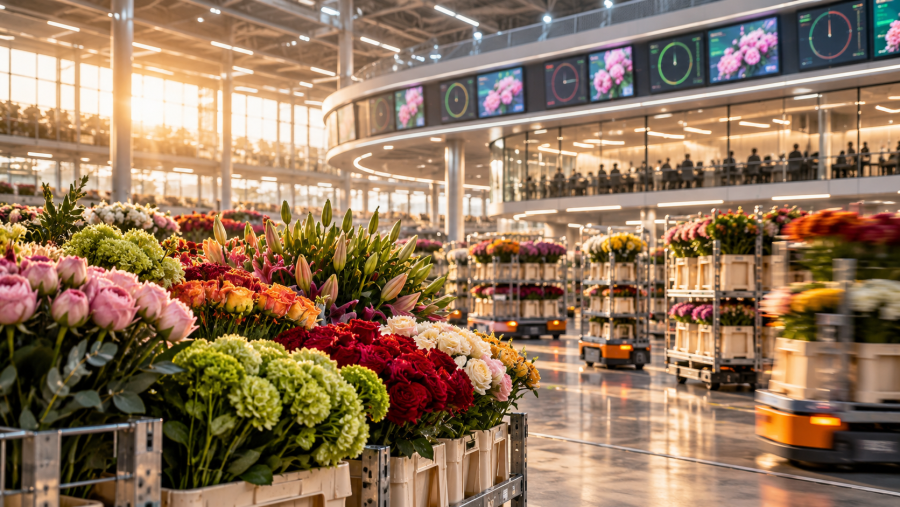
And now, let's take a behind-the-scenes look at one of the world's largest flower auctions. In the Netherlands, Royal FloraHolland is preparing for another stage of trading modernization in Aalsmeer.
At the end of October, auctioneers working with cut flowers will move into renovated studios at the Expedition Centre Aalsmeer. Specialists trading potted plants and buyer representatives are already working there. Now, they will all be able to interact within a shared space.
According to the organizers, this should improve coordination and make the trading process more convenient for everyone involved.
And here's the most interesting part: from November 3 to 5, during the international Trade Fair Aalsmeer, visitors will have the opportunity to go behind the scenes of the upgraded auction, learn more about the auctioneers' work, and watch a demonstration of the new trading studios. [5]
Good News: One Bouquet for Yourself, Another for a Stranger!
And finally, a story that reminds us why flowers have the power to make the world a little kinder.
On October 14, the annual Petal It Forward initiative, organized by the Society of American Florists, took place in the United States.
The idea is incredibly simple: participants give passersby two bouquets at once. One is theirs to keep, while the other is meant to be passed on to someone else. In this way, one unexpected gift becomes the beginning of a whole chain of wonderful surprises.
This year, for example, the flower company George's Flowers, together with its partners, prepared 3,200 free bouquets for the initiative in Roanoke.
Just imagine: you're simply going about your day when someone unexpectedly hands you flowers and invites you to share the joy with another person. That's how an ordinary bouquet turns into a little story of human kindness! [6]
And that's what this week in the world of flowers has been all about! New achievements in plant breeding, changes in international trade, the modernization of flower auctions, technologies of the future, and, of course, acts of kindness that remind us that the flower industry is not just about business, but also about people.
And now, we'd love to hear from you! If something interesting has happened at your company, you've developed a new flower variety, introduced an unusual technology, or have an inspiring story from your flower business, send it our way! If your story aligns with our editorial philosophy, we'll be delighted to share it in one of our upcoming editions.
Stay on top of industry trends with Flores Agency, grow your business, and remember: good news needs to be cultivated, too!
See you next week!
Sources
[1] Red Marigolds: Official Decision by the U.S. Department of Agriculture (USDA)
[2] New Chrysanthemum Import Regulations. AmericanHort Announcement. Official APHIS Decision
[3] Artificial Intelligence in Orchid Cultivation. LetsGrow.com Publication
[4] PeelON Packaging Trials for Cut Flowers. FloralDaily Article
[5] Royal FloraHolland Auction Modernization. FloralDaily Article. Additional Coverage by BPnieuws
[6] Petal It Forward Initiative. Official Society of American Florists Website. George's Flowers Event in Roanoke