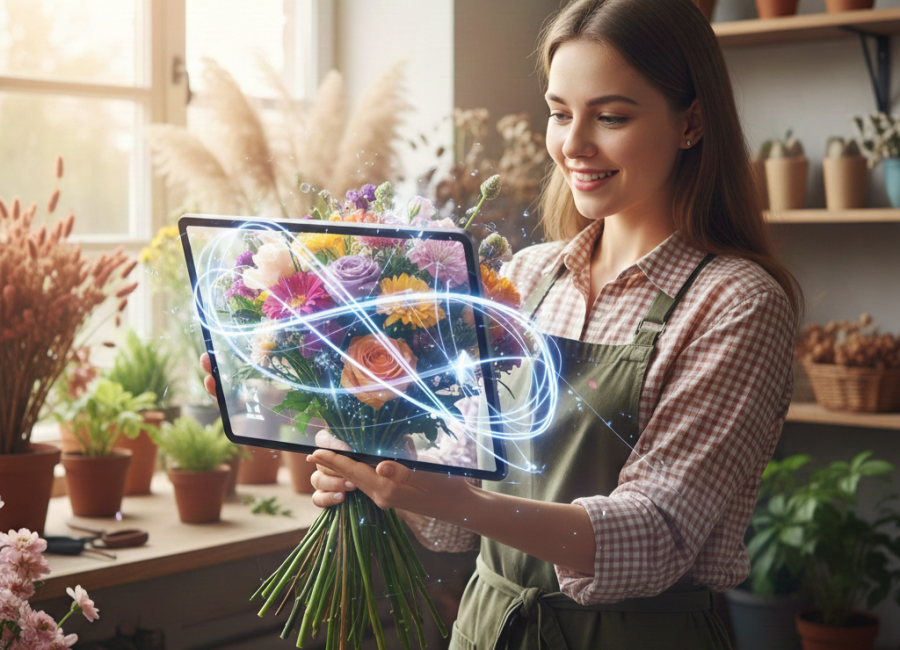
Augmented reality has long since moved beyond entertainment. Today, it's used in retail, medicine, architecture, and education. Now, it's floristry's turn: AR helps designers and florists show clients the future—what a bouquet, interior, or wedding decor will look like even before they're created.
These technologies are opening up new horizons. They allow businesses not only to stand out from the competition but also to speak a language that resonates with today's customers: the language of emotion, visuals, and digital experiences.
What is AR and how is it different from VR?
It is important not to confuse AR and VR.
- VR (virtual reality) completely immerses a person in an artificial world. This includes a helmet, glasses, and game worlds.
- AR (augmented reality) overlays digital objects onto real space.
AR makes it possible to "try on" a bouquet on a client's table or see a wedding arch in an empty hall. For floristry, it's valuable because it combines live material (flowers) with a digital layer that helps visualize the result in advance.
AR in design: new opportunities for florists
Florists often have to work with their clients' imaginations. Some easily envision a composition based on a verbal description, while others are lost and uncertain. Here, AR becomes a true assistant: just open the app, and the bouquet "appears" on the phone screen right in the client's room.
AR also removes barriers for large orders. For example, newlyweds can see how their hall will look in advance with decor and approve the design without trial assemblies. And a corporate client can "try out" window dressing or office decor.
Furthermore, AR opens up creative possibilities. "Animated" packaging with care tips, virtual greetings, animations that appear when you point the camera at the bouquet—all this transforms flowers into part of a unique digital experience.
AR in marketing: new promotion tools
Marketing always strives to surprise. AR offers powerful tools for this.
Imagine an advertising banner that comes to life and displays a floral arrangement in 3D. Or an Instagram filter that allows you to "try on" the bouquet and take a photo for social media. This kind of content evokes emotion and easily goes viral.
For floristry, this is a chance to go beyond classic ads and establish themselves as an innovative brand. This is especially powerful for younger audiences: for them, AR isn't exotic, but a natural way to interact with the world.
Application examples
Today, AR is already being implemented in floristry in a targeted manner, but the results are impressive:
- apps allow you to try out bouquets in your interior before purchasing;
- wedding agencies are using AR to showcase the decor of their venues;
- QR codes on packaging lead to virtual cards or videos with congratulatory messages;
- marketplaces are testing a "view product in real size" feature.
Limitations and barriers
But AR still has its own challenges:
- high cost of app and content development;
- a shortage of specialists skilled in AR in niche areas;
- not all clients are willing to download apps and actively use cameras;
- the risk that AR will be perceived as a "toy" if it doesn't provide practical benefit.
It's important for florists to remember that technology should enhance the value of a product, not detract from it.
The future of AR in floristry
In a few years, AR could become as commonplace as Instagram is today. The following scenarios are possible:
- virtual florists, where customers create bouquets in an app and see the results immediately;
- AR installations in the city, where digital effects are superimposed on street flower arrangements;
- online stores with "try-on" options, where customers can see the bouquet on their desk before ordering;
- digital stories accompanying the bouquet: for example, a unique animation or a personalized video greeting.
AR will become not just an additional service, but an important part of marketing and service.
Conclusion
Augmented reality helps florists and designers remove the barriers between idea and reality. Clients can see their future arrangement in advance, confirm their choice, and experience the emotions even before receiving the bouquet.
For businesses, this is a powerful differentiation tool: a florist who knows how to use AR is perceived as a next-generation professional. In the coming years, these companies will set the tone in the market.
AR won't replace real flowers, but it will make them even more valuable, turning each bouquet into a story where beauty meets technology.
Your experience matters! Take a short survey and see what answers other flower business representatives gave. Take part