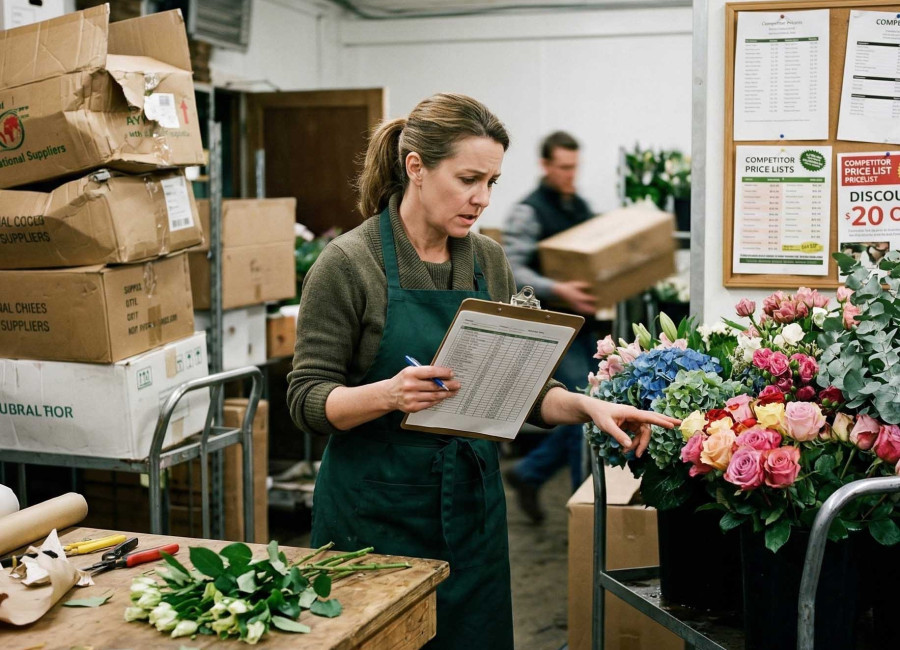
The flower business in 2026 is increasingly facing not a problem of sales, but a problem of hidden profit losses. Despite stable revenue, companies lose up to 20–30% of their income at the stages of procurement, logistics, and sales—without even recording it in their reporting. These losses do not appear as mistakes and rarely show up in analytics, yet they are what ultimately determine the real profitability of the business.
A company may demonstrate stable turnover, maintain its average order value, and even consider itself profitable, while systematically losing a significant share of its potential profit. These losses are embedded in processes and are perceived as “normal operations”: write-offs, discounts, “imperfect” quality, leftovers. As a result, the business adapts to inefficiency instead of eliminating it.
The core issue is that hidden losses in the flower business are distributed across the entire chain—from procurement to final sale. They cannot be identified in a single place, which is why they are rarely analyzed. Yet it is precisely their combined effect that creates the gap between revenue and actual profit.
Where Hidden Losses in the Flower Business Are Formed
A common misconception is that the main losses occur at the retail level: unsold flowers, write-offs, discounts. In reality, this is only the final stage. The majority of losses are formed much earlier—during procurement, logistics, and initial storage.
A flower passes through a long chain, and at each stage it loses part of its resource. Even under standard conditions, there is a gradual decline in its “life potential.” At the same time, this effect is underestimated at every stage, because visually the product may still appear acceptable. As a result, what reaches the point of sale is already partially “spent,” yet is evaluated as a full-value product.
This creates a fundamental problem: the business believes it is selling a fresh product, while in reality it is selling a product with a limited selling window. This shortens the time available for sale, increases the risk of write-offs, and reduces the final price at which the product can be sold.
The Illusion of Quality: How a “Normal” Flower Reduces Profit
One of the most underestimated issues is the perception of quality. The industry is still dominated by a visual criterion: if a flower looks fine, it is considered suitable for sale. But in 2026, this is no longer sufficient. The key metric is not how the product looks at the moment, but how it behaves after the sale.
A flower that opens too quickly or loses its shape creates a negative customer experience. The client may not return the product, but they register the decline in quality. This affects repeat purchases, trust, and willingness to pay. In the long term, this leads to a decrease in total revenue, even though the issue may not be visible at the level of individual transactions.
Thus, a “normal” flower becomes a source of hidden losses in the flower business. It is sold, but it undermines future profit. This is one of the most difficult processes to diagnose, because it does not directly appear in reporting.
Key Areas of Hidden Losses in the Flower Business
If we break down the supply and sales chain, it becomes clear that losses are systemic. They are not concentrated in a single point but are distributed across processes that are rarely analyzed as a unified system.
The main areas of hidden losses in the flower business are:
• procurement without a clear understanding of demand, leading to illiquid stock and forced discounts;
• logistics with deviations in timing and temperature, reducing the lifespan of the flower before it reaches the point of sale;
• storage without proper rotation, causing part of the stock to lose quality before being sold;
• write-offs that are perceived as inevitable rather than as the result of systemic errors;
• price reductions to accelerate sales that are not recorded as margin loss.
Each of these factors alone may not seem critical. But together they form a stable model in which the business loses a significant share of profit every day.
Procurement Error: How Losses Are Formed Before the Sale
Procurement is not just about selecting products—it is the point where future profit is determined. At the same time, most companies manage procurement intuitively: relying on experience, seasonality, or a subjective sense of demand. This creates systemic inaccuracy.
Excessive assortment leads to a situation where part of the product does not find its buyer at the right time. It is either sold at a discount or written off. Insufficient assortment, on the contrary, leads to missed sales. In both cases, the business loses money but perceives it as a natural market fluctuation.
In 2026, it becomes clear that success comes not from increasing procurement volume, but from improving its accuracy. Companies that know how to manage assortment, rather than simply expand it, achieve higher turnover and stable margins. This is where a significant part of hidden losses in the flower business is formed.
How Logistics Reduces Profit in the Flower Business
Logistics remains one of the most underestimated factors in the flower business. Even minimal deviations in temperature or delivery timing can significantly affect product quality. At the same time, these changes are rarely recorded as a problem.
The flower arrives, looks acceptable, and goes on sale. But its lifespan is already reduced. This means the business has less time to sell it, a higher risk of write-offs, and lower quality for the customer. As a result, logistics affects not only costs but also revenue, although this is not always obvious.
Companies that begin to manage logistics as a quality factor, not just as a delivery process, gain a significant advantage. They work with a “longer” product and have more time to sell it without reducing the price.
Why Businesses Do Not See Hidden Losses
One of the key reasons hidden losses persist is the lack of a systemic view. Businesses evaluate results based on final figures: revenue, procurement, inventory. But they do not analyze how profit is actually formed.
The problem is that losses are “spread” across processes. They do not appear as a single deviation. Each of them seems minor and explainable. As a result, normalization occurs: the business gets used to losses and stops perceiving them as a problem.
In addition, there is no connection between stages. Losses in logistics are not linked to sales, procurement errors are not linked to write-offs, and quality is not linked to customer return. This makes the system opaque. Until this connection is built, the business cannot see the real scale of the problem.
How Hidden Losses “Eat” Profit: The Chain Effect
The most important point is not individual losses, but their sequence. They do not simply add up—they reinforce each other. An error at one stage increases the load on the next.
If a flower arrives with already reduced quality, it loses its appearance faster. This shortens the selling window, increases the likelihood of discounts, and raises the risk of write-offs. As a result, one error turns into multiple losses at different stages.
A typical chain of losses looks like this:
• procurement without accurate forecasting → excess or mismatched assortment;
• logistics reduces the product’s resource → shorter selling period;
• the product stays longer on display → deterioration of appearance;
• price reduction is required → margin decreases;
• part of the product remains unsold → write-off.
Each step amplifies the previous one. That is why total losses are significantly higher than they appear at the level of individual operations.
What Changes in 2026
The market is becoming more sensitive to efficiency. Pressure on margins is increasing, competition is growing, and customers are becoming less loyal. This means hidden losses can no longer be ignored—they directly affect business sustainability.
Companies that begin to work with these losses systematically gain a real advantage. They do not necessarily sell more, but they earn more from the same volume. This is a fundamental difference: profit growth without revenue growth.
In 2026, managing hidden losses becomes a key factor in the profitability of the flower business.
Conclusion: Profit Is Lost in the System, Not in One Place
The flower business does not lose money in a single place. Losses are distributed across the entire chain, which is why they remain unnoticed. Each of them seems insignificant, but together they create a substantial gap between revenue and real profit.
The main conclusion is that profit is not only the result of sales—it is the result of process management. And if a business does not control these processes, it inevitably loses money, even with stable revenue.
The harsh but accurate statement for 2026 is this: if you do not understand where you are losing, you do not know how much you are actually earning. And this is where real business management begins.
Your experience matters! Take a short survey and see what answers other flower business representatives gave. Take part